2026-10-30
Testing a mattress properly: the ten minutes that decide
By Passion for Beds

An independent mattress test can compare quality and measurable properties. A test winner will not automatically suit every body. Tension, sleeping position, base and personal perception still need to be assessed. That is the purpose of trying a mattress in person.
Independent tests can compare workmanship, durability, body support, pressure distribution and other measurable properties. They cannot fully represent how a mattress feels for your body. Laboratory results and a personal showroom test therefore answer different questions.
Independent test
compares measurable properties
- Workmanship
- Durability
- Body support
- Pressure distribution
Trying it in person
shows what suits your body
- Tension
- Sleeping position
- Base
- Personal perception
A test winner will not automatically suit every body.
Test in your normal sleeping position
One mistake is testing in the wrong position. If you fall asleep on your side, a brief test on your back says little about your usual experience. Lie the way you actually fall asleep, even if it feels unfamiliar in a showroom.
The second mistake is duration. Vispring recommends testing each bed for at least ten minutes. Do not remain still in an unfamiliar position. Lie as you normally fall asleep, turn over several times and only then compare the next option.
What you check in those ten minutes comes down to three things. First: does the shoulder sink in without the upper body tipping? Second: does the hip sit at the same height as the shoulder, or does the spine bend sideways? Third: is there a gap between your lower back and the mattress that a flat hand fits into and slides out of again?
- Lie as you fall asleep
- Turn over several times
- Check three things
- Only then the next option
Shoulder
Does it sink in without the upper body tipping?
Hip
Does it sit at the same height as the shoulder, without bending sideways?
Lower back
Does a flat hand fit into the gap and slide out again? Only one additional clue.
Vispring recommends the ten minutes for every bed, in the position in which you normally fall asleep.
The hand check is only one clue
The hand check can add one observation, but it is not a tension test on its own. Lying on your back, slide a flat hand beneath your lower back and compare several mattresses. At the same time, consider whether pelvis and ribcage lie calmly, whether pressure develops and whether you can relax. One hand-sized gap cannot decide whether a mattress fits.
Bring your own pillow. A strange pillow at the wrong height distorts everything you feel at shoulder and neck, and you then test two things at once without knowing which one is the problem. If the pillow is obviously wrong, that is a result too.
Two sleepers need two perspectives
Test as a pair if you share the bed. Different body weights or preferences may make separate tensions useful. Assess both sides independently and check movement transfer as well: one person remains still while the other turns over or gets up.
- Different body weights or preferences may make separate tensions useful.
- Assess both sides independently.
- Check movement transfer: one person remains still while the other turns over or gets up.
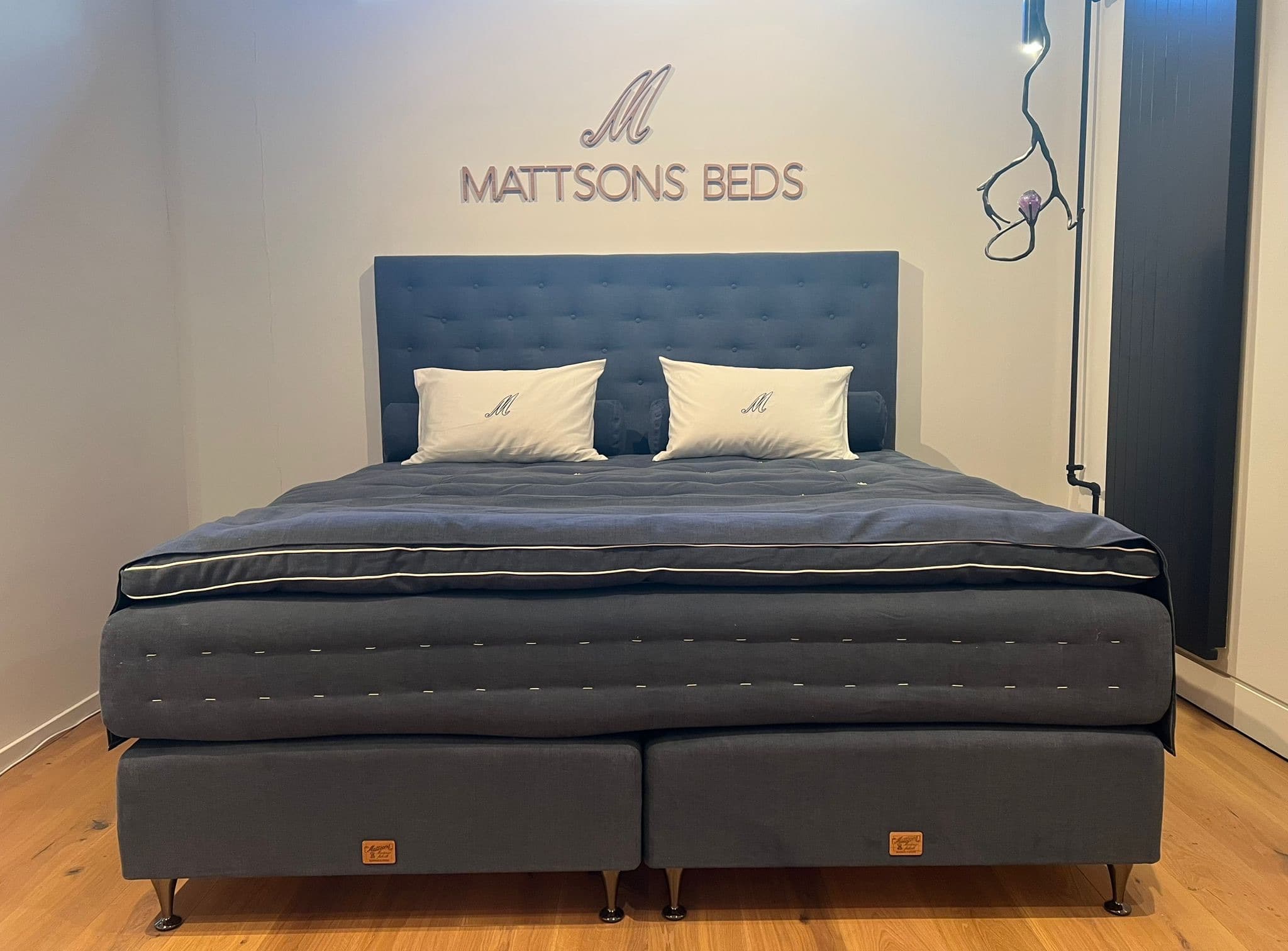
Mattsons Beds in the passion for beds showroom in Zurich.
Tension is not a quality mark and the labels are not standardised between manufacturers. Body weight and sleeping position provide a starting point. What matters is how support and pressure distribution work for you in the complete bed system.
Test in normal clothing without a thick jacket and remove your shoes. Keep the conditions as similar as possible for every model. If you are tired or already tense, note that as well. This makes the comparison easier to interpret.
A traceable consultation asks about build, sleeping position, the existing bed and personal perception. It should then explain why a particular construction is being proposed. Have the model, tension and relevant materials recorded in writing.
Start with one reference model and then change only one element at a time, such as tension or topper. If several components change together, the difference is difficult to attribute. Record the order and your impression briefly on paper or your phone.
Reference model
Starting point
- Tension
- Topper
- Pillow
- Sleeping position
Second test
only the tension changes
- Tension
- Topper
- Pillow
- Sleeping position
Third test
only the topper changes
- Tension
- Topper
- Pillow
- Sleeping position
If several components change together, the difference is difficult to attribute. Record the order and your impression briefly.
Check everyday movement as well as shoulder and pelvis. Can you turn, sit up and stand from the edge without unnecessary effort? These movements are part of personal comfort and can be compared directly in the showroom without turning the observation into a medical claim.
Check sleep trials and their conditions
Sleep-trial offers vary substantially. Some allow a return, while others offer exchange only. Deadlines, minimum-use periods, mattress protectors and collection charges may form part of the terms. Read those rules before buying and never assess a trial by the number of nights alone.
Compare consistently and decide calmly
Compare models under conditions that are as similar as possible. Use the same pillow, the same sleeping position and roughly the same test duration. After each option, note three things: where pressure develops, how steadily the pelvis lies and whether you feel an urge to move away. That turns memory into a consistent comparison.
Where does pressure develop?
How steadily does the pelvis lie?
Do you feel an urge to move away?
Same pillow, same sleeping position, roughly the same test duration. That turns memory into a consistent comparison.
Ask for the exact return or adjustment process before ordering. The useful details are the deadline, required condition, possible transport cost and whether the tension can be adjusted or only the whole mattress exchanged. A sleep-trial promise helps only when the conditions are clear.
Temperature and climate are difficult to judge in ten minutes. Ask which materials sit directly beneath the cover, how the topper is cared for and what documented guidance exists for people who tend to sleep hot or cold. Look for a clear construction specification rather than a promise about a personal sensation.
Do not make the decision at the door. Have the model, tension and construction written down, take a short break and then lie on the favourites once more. A second round often shows more clearly whether the first impression remains consistent.
Compare complete systems. The same mattress may feel different on another base or with another topper. Ask which base, mattress and topper were used in the display bed and confirm that the same combination appears in your quotation.
A mattress is used night after night. Give every favourite at least ten minutes, use your normal pillow and write down the complete model name. The decision then remains traceable after several comparisons.
Frequently asked questions
How long should you try a mattress?
Vispring recommends at least ten minutes per bed. Test in the position in which you normally fall asleep, turn over several times and compare every model under the same conditions.
Are online mattress tests any use?
Independent tests can compare durability, support, pressure distribution and workmanship. They cannot fully represent personal feel. Use test results together with a consistent showroom comparison.
How do I tell if a mattress is too firm or too soft?
Not with one isolated test. Compare pressure, relaxation and the position of shoulder, pelvis and ribcage in your normal sleeping position. The hand check beneath the lower back is only one additional observation and does not determine tension by itself.
Do two people need the same firmness?
Not necessarily. Different body weights, sleeping positions or preferences may make separate tensions useful. Confirm before ordering whether the selected model allows a split or combination-tension construction.
Sources
Keep exploring